What It Really Means to Track the Cycle in Couples Therapy

Key points
Tracking the cycle builds the scaffold that makes vulnerability safe.
Mapping interactions shifts blame into process and gives partners something to do.
A practical approach that helps couples move from reactivity to repair.
When I first dove into Emotion Focused Couples Therapy, I was eager to pry open feelings and get straight to the heart of things. I quickly learned that jumping to deepening without a map can feel like handing couples a parachute without checking the ripcord. Slowing down to track the negative interactional cycle first is a little less glamorous, a lot more effective, and frankly a kinder way of doing Couples Therapy.
Tracking Is Not Just a Technique
Many therapists and couples assume therapy is about one powerful insight or a big emotional confession that changes everything. That’s the romantic story, but it rarely matches the messy reality of relationships. Tracking the cycle reframes the work as a practical, observable process: you notice the moves, name the loop, and give partners language and somatic cues to orient themselves in the moment. This isn’t top-down teaching for its own sake; it’s a bottom-up, experiential strategy that helps partners feel their way through interactions. When you make the cycle visible, you create safety, reduce shame, and invite curiosity instead of accusation so the deeper emotional work that follows actually lands.
Why This Matters in Relationships
It highlights bodily signals that predict escalation and withdrawal.
It shows how good intentions can turn into hurtful actions and defensive retreats.
It offers a predictable sequence partners can learn to interrupt.
It creates a safer context for primary emotions to emerge. When couples can point to the cycle, they stop describing each other as the problem and start seeing a shared pattern they can change. That shift matters because most couples aren’t asking for tips on chores or schedules; they’re asking, implicitly, How do I stop arguing with my partner? Tracking gives them a practical route out of repeated fights.
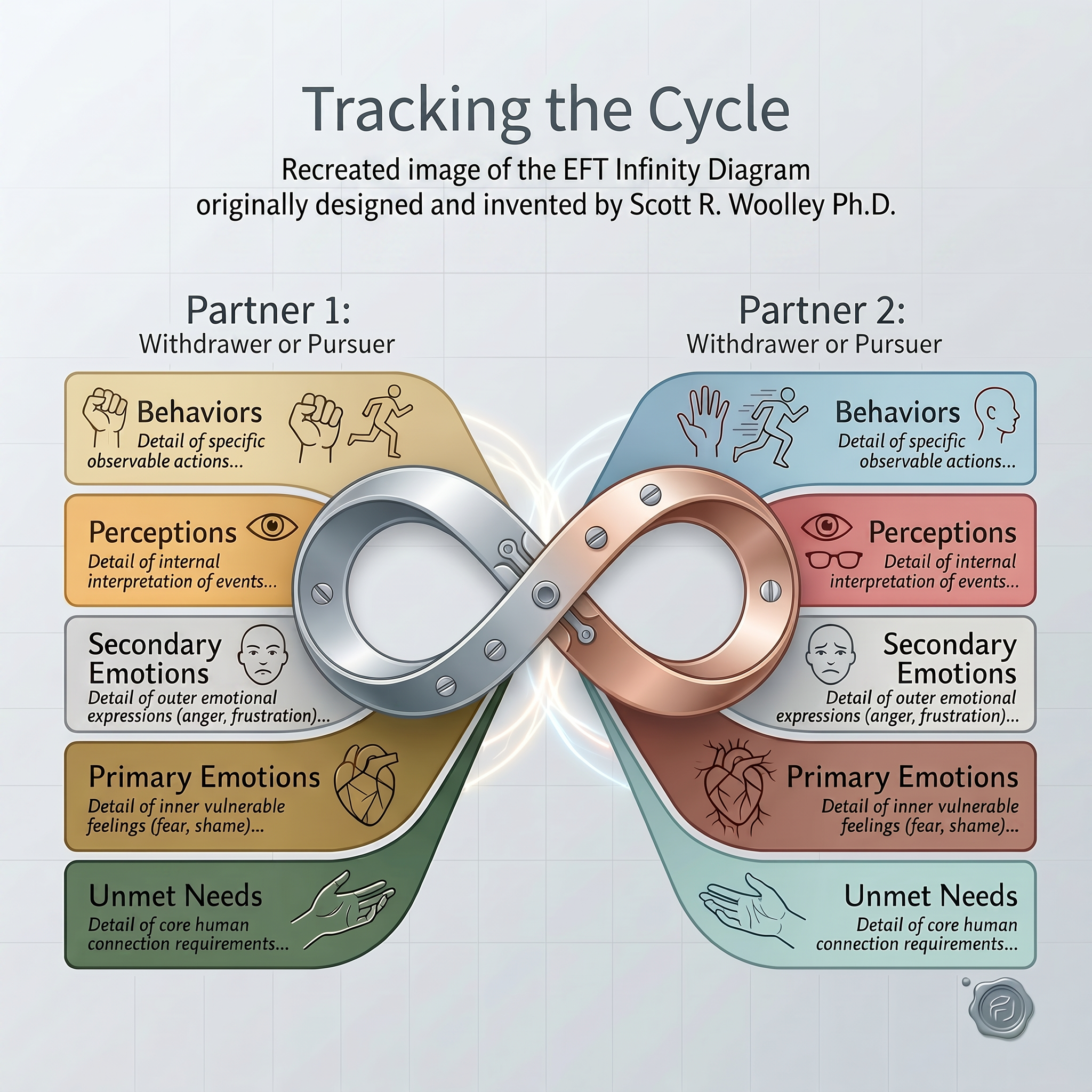
Grounded in the negative interaction cycle framework of Emotionally Focused Therapy (Johnson & Greenberg, 1985; Johnson, 2004). Infinity loop representation informed by contemporary EFT training models (e.g., Woolley).
What Tracking the Cycle Teaches Us
Tracking is an experiential, bottom-up practice consistent with core EFT principles. Instead of lecturing about attachment or handing out insights, you invite partners to notice the felt sense in their bodies, the micro-moves that escalate or soothe, and the stories that spin in their heads in the moment. For example, criticism often masks fear of being unseen, and withdrawal often protects against feeling flooded. I talk more about why partners shut down in this article here. Naming that cycle through bodily sensation, thought, reactive move, and partner response creates an accessible map for change. This method is helpful whether you’re Learning Emotion Focused Couples Therapy as a clinician or using it as a framework in virtual sessions. It’s how emotion becomes information rather than ammunition.
Practical Tips for Tracking the Negative Interactional Cycle
Start by setting the stage in early sessions: tell the couple you will be taking them on a journey of mapping their disconnection. Use their language for the experience like “stonewalling,” “sniping,” “zoning out,” whatever resonates so they buy in faster.
Ask them to imagine you were a fly on the wall during their last fight and describe what you’d see; that’s your foot in the door for mapping interaction.
Use somatic and experiential questions to assemble emotion: What do you feel in your body as you talk about this? What emotion comes up when you notice your partner shutting down or attacking? What narrative runs through your head in those moments? These prompts move the work from intellectual to felt and help partners own their part of the loop. If by session five through ten your couple looks confused when you introduce the cycle, pull out a visual loop. EFT’s negative interactional cycle diagram is a clear, nonjudgmental tool. Visuals help many clients, including neurodivergent partners, translate experience into understandable steps. Keep referencing the cycle in-session; every moment of disconnection is an opportunity to map the loop live.
Remember what stage you are in. Whether you use EFT or not, knowing where your couple is and how far along they are in the couples therapy process is key. Tracking is stage one. When both partners can reliably identify their moves and their partner’s moves, you can move into stage two, deepening primary emotion and uncovering disowned needs. It’s not about avoiding arguments; it’s about the couple experientially learning to move through them differently.
Be aware there can be multiple overlapping cycles: the cycle happening right now, the cycle reflected in what the couple is discussing in session, and the positive cycle that demonstrates repair and/or connection. Track all three as needed so you know where the couple is within their cycle and how to get them to where they want to be.
What Tracking Actually Looks Like in Session
A couple started seeing me and were clearly stuck and felt chronically distant. I asked them to describe what a recent argument looked like if I had been a fly on the wall. One partner described escalating frustration; the other described pulling away and going quiet. Hearing the loop aloud made both partners visibly softer. We practiced a small interruption: one partner naming the pull, the other offering a micro-repair. That tiny change was the start of a new positive interactional cycle that became their go-to when stress rose.
Navigating Challenges or Change
Life stressors, work, parenting, and health issues tend to intensify cycles rather than replace them. In online practice, whether you specialize in Online Couples Therapy in Texas or provide Online couples therapy in Florida, you can still reliably track these patterns by pausing, inviting somatic noticing, and using visual aids. Tracking during moments of disconnection is a powerful way to keep emotion grounded and to experientially teach partners how to summon the positive cycle when they are outside therapy.
Tracking the cycle matters because it turns chaos into a map. When couples can name the loop that traps them, they can choose a different exit. Tracking does not stop conflict; it teaches partners how to move through conflict and return to connection. Repeat after me: tracking matters!
If you are seeking Online couples therapy in Florida or Online Couples Therapy in Texas, working with an EFT-trained therapist can help you map and shift the patterns keeping you stuck.
References Johnson, S. M. (2004). The practice of emotionally focused couple therapy. Brunner-Routledge.
Johnson, S. M., & Greenberg, L. S. (1985). Emotionally focused couples therapy: An outcome study. Journal of Marital and Family Therapy, 11(3), 313-317. DOI: 10.1111/j.1752-0606.1985.tb01063.x